

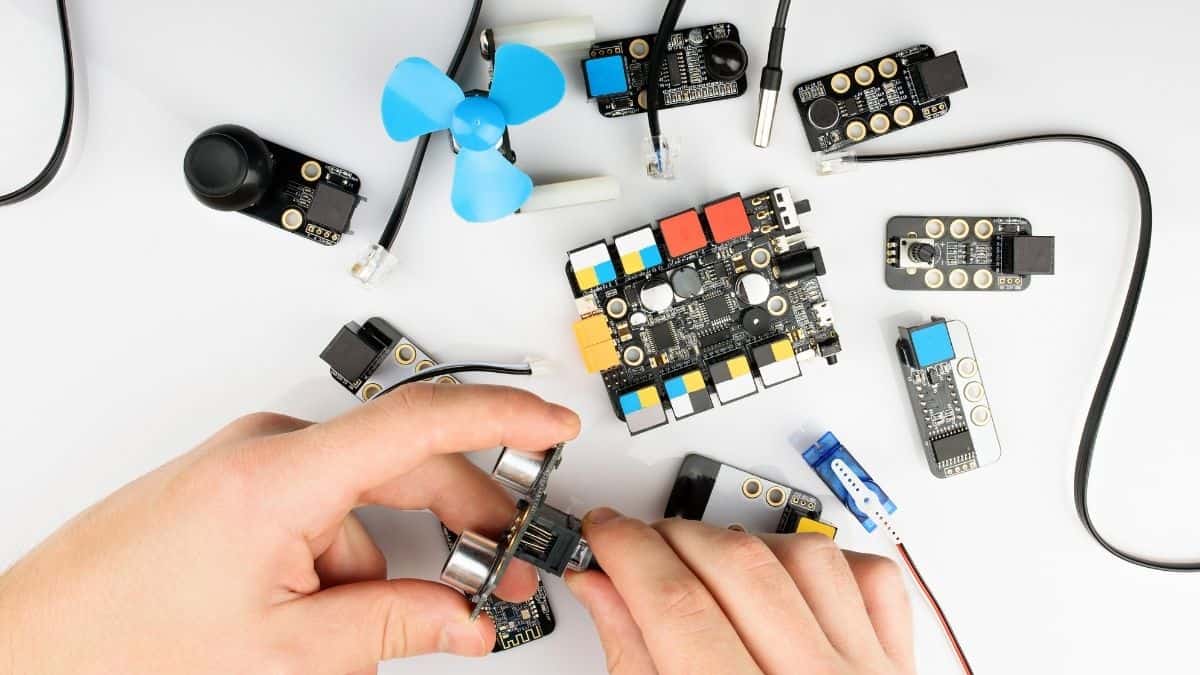
Best Robotics Kits for High School Students

By high school, a lot of teens who liked snap-together robots are ready for the real thing: a controller board they program themselves, sensors that feed back numbers, and code written in the same tools engineers use, such as the Arduino IDE or Python on a Raspberry Pi. The six kits below are aimed at that step. They range from a first robot car that comes with everything in the box to legged Raspberry Pi robots for students who already know their way around a breadboard.
We chose these from current Amazon listings, not hands-on testing, so the ages and specs are the makers’ own and the notes on fit are our recommendations. Pay close attention to the “What else you need” column: several of these kits ship without the board, batteries or computer they run on. Some links on this page are affiliate links, and STEMGeek may earn a commission if you buy through them.
The six picks at a glance
| Pick | Maker’s age | Best for | What else you need |
|---|---|---|---|
| ELEGOO Smart Robot Car Kit V4 Check price on Amazon | 12+ | A first Arduino robot with everything in the box | A computer for coding |
| ELEGOO UNO R3 Most Complete Starter Kit Check price on Amazon | 13+ | Learning the electronics inside a robot | A computer for coding |
| ELECFREAKS Mini Cutebot (micro:bit robot car) Check price on Amazon | Not stated on the listing | Low-cost robotics for micro:bit users | A micro:bit board, AAA batteries and a computer or tablet |
| Makeblock mBot Ranger 3-in-1 Check price on Amazon | 10+ | Beginners who want metal parts and three builds | 6 AA batteries and a computer or tablet |
| Freenove Big Hexapod Robot Kit for Raspberry Pi Check price on Amazon | Not clearly stated | A long Raspberry Pi and Python build | A Raspberry Pi, 18650 batteries and a computer |
| SunFounder PiDog AI Robot Dog Kit Check price on Amazon | 15+ | Robotics plus computer vision and AI voice | A Raspberry Pi and a computer |
Shopping for a younger sibling too? Our robotics kits for middle school guide covers mBot2, Edison and Sphero RVR+, which suit ages 8 to 13 better than most of the kits here.
Our picks
1. ELEGOO Smart Robot Car Kit V4

From the listing:
- Model US-EL-KIT-012. The listing’s details give an age of 12 and up; its description recommends 8+ with adult guidance for first-time builders.
- Includes an ELEGOO UNO R3 controller board, an ESP32-based camera and Wi-Fi module, line-tracking and ultrasonic sensors, motors, an IR remote and a 2000 mAh rechargeable lithium-ion battery.
- Programmed with the Arduino IDE; it can also be driven from the ELEGOO app or the IR remote, with live first-person video from the camera.
- Keyed connectors and an illustrated tutorial walk through the wiring and assembly step by step.
Why it suits high schoolers: It’s a complete Arduino robot in one box, so the first weekend goes to building and the next ones go to changing the example code: how it reacts to the ultrasonic sensor, how tightly it follows a line, which driving modes it uses. Editing working code is a practical way to learn embedded programming.
Good to know: You’ll need a computer to install the Arduino IDE and upload code. “Compatible with Arduino” means the controller is ELEGOO’s own UNO R3 board rather than an official Arduino; our Arduino Uno vs ELEGOO Uno comparison explains what that means in practice.
2. ELEGOO UNO R3 Most Complete Starter Kit
From the listing:
- Model EL-KIT-001, ages 13 and up.
- More than 200 components across 63 types, including an UNO R3 controller, ultrasonic sensor, servo, stepper motor, LCD1602 display, keypad and RFID module.
- More than 30 guided projects with a PDF tutorial and example code, programmed in the Arduino IDE.
- No soldering: modules come pre-soldered and circuits go on a solderless breadboard. A 9V power supply, 9V battery and USB cable are included.
Why it suits high schoolers: It isn’t a robot on its own, but it teaches what every robot is made of: reading sensors, driving servos and stepper motors, and showing data on a display. A teen who works through these projects will understand a robot kit rather than just assemble one, and the parts can go straight into their own build-a-robot projects afterward.
Good to know: There’s no chassis, wheels or drive motors for a rolling robot, so pair it with one of the kits below if they want something that moves around the room. The tutorial is a PDF rather than a printed book.
3. ELECFREAKS Mini Cutebot (micro:bit robot car)
From the listing:
- A small programmable robot car that works with micro:bit V2 and V1 boards.
- Supports distance tracking, obstacle avoidance and line following, programmed with MakeCode graphical blocks.
- Has a 3-pin port for adding sensors and works with building-block parts for custom shapes.
- The micro:bit board and AAA batteries are not included, and the listing notes that the ultrasonic module must be plugged into the front port for the car to work.
Why it suits high schoolers: It’s the least expensive way into this list and a natural next step for teens who met the micro:bit in a middle school class. Because the board does the thinking, they can focus on the logic of sensing and steering with very little wiring.
Good to know: Add a micro:bit board and AAA batteries to your cart, since neither is in the box. The listing describes block-based MakeCode programming; if your teen wants text-based code, check ELECFREAKS’ online wiki for the options before buying. It’s also small and simple compared with the other picks, so it suits a beginner or a classroom set better than an experienced coder.
4. Makeblock mBot Ranger 3-in-1
From the listing:
- Ages 10 and up, model MBR-K01-01.
- Builds three robots: Land Raider (a tracked tank), Nervous Bird (a self-balancing robot) and Dashing Raptor (a three-wheeled racer).
- The Me Auriga mainboard carries ultrasonic, line-tracking, light, gyroscope and temperature sensors, 12 RGB LEDs, a buzzer and Bluetooth.
- Programmed in Scratch or Arduino through the mBlock 5 app. Needs six AA batteries or lithium batteries, which are not included.
Why it suits high schoolers: The self-balancing build is a genuine control problem, using the gyroscope to stay upright, which is a step up from line-following cars. And because mBlock moves from Scratch blocks to Arduino code in the same app, a 14-year-old who is new to coding can start with blocks and switch to text when ready.
Good to know: With an age marking of 10+, it’s best for a younger teen or a beginner; a confident coder may want one of the Raspberry Pi robots instead. Batteries are extra. It’s a different product from the mBot and mBot2 in our middle school guide.
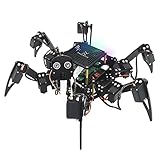
5. Freenove Big Hexapod Robot Kit for Raspberry Pi
From the listing:
- Model FNK0052. Each of the six legs has three motors, and the rotating head carries a camera and an ultrasonic distance sensor.
- Comes with a step-by-step assembly guide and complete Python code to download (there’s no paper tutorial).
- Works with Raspberry Pi 5, 4B, 3B+, 3B and 3A+; some other Pi models need extra parts.
- Controlled from an Android or iPhone app, or from a Windows, macOS or Raspberry Pi OS computer.
- The Raspberry Pi and batteries are not included; the listing names 3.7V 18650 rechargeable batteries and the tutorial says which to buy.
Why it suits high schoolers: Eighteen motors walking in coordination is a serious engineering project, and the complete Python code gives a student working examples of walking, face recognition and distance sensing to read, change and extend. It’s a good fit for a teen who already has a Raspberry Pi, or wants a project that lasts weeks rather than an afternoon.
Good to know: Plan for a Raspberry Pi and 18650 batteries on top of the kit price. The listing’s age fields contradict each other, so we’d ignore them: the long build and Python focus make it a match for older teens.
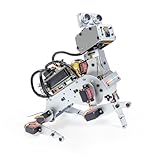
6. SunFounder PiDog AI Robot Dog Kit
From the listing:
- Ages 15 and up; described as an AI development robot for students, makers and tech enthusiasts.
- Runs on Raspberry Pi 5, 4B, 3B+, 3B or Zero 2W; the Raspberry Pi is not included.
- 12 servos for 32 dog-like actions, with ultrasonic, touch, gyroscope and sound sensors plus a camera, speaker and microphone.
- Supports Python, OpenCV, MediaPipe, text-to-speech and speech-to-text, app control and connections to large language models such as ChatGPT and Gemini.
- Two lithium-ion batteries are listed as included, and the frame is aluminum.
Why it suits high schoolers: PiDog combines classic robotics (servos, balance and touch sensing) with the computer vision and AI voice features many teens are most curious about. Its 15+ marking matches upper high school, and the Python and OpenCV support means the skills carry over to science fair and club projects.
Good to know: You’ll need to supply a Raspberry Pi. The AI conversation features rely on outside AI services, so check SunFounder’s documentation for what accounts they need before promising a talking dog on day one.
How to choose a robotics kit for a teen
- Arduino or Raspberry Pi? Arduino-style boards (the ELEGOO kits and mBot Ranger) run one program in a loop and are written in C/C++ through the Arduino IDE. A Raspberry Pi (Freenove Hexapod, PiDog) is a small Linux computer, programmed mainly in Python, with room for cameras and vision projects. Our Arduino vs Raspberry Pi explainer goes deeper.
- Count the extras before you buy. The Pi robots need a Raspberry Pi board, and the Hexapod also needs its own batteries. The Mini Cutebot needs a micro:bit and AAA batteries, and mBot Ranger takes six AA batteries. Every kit here needs a computer (or, for some, a tablet) for programming. If a Pi isn’t already in the house, our Raspberry Pi starter kits guide can help.
- Match the build to their experience. A teen who has never wired a circuit will get further with the ELEGOO car or the starter kit first. The legged robots are long builds that reward patience and some prior tinkering.
- Think about where it will run. Projects like these do well in a robotics club or school makerspace. Our makerspace ideas for high school has ways to turn one kit into a longer project.
Frequently asked questions
What is a good first robotics kit for a 14-year-old?
For a teen with no electronics experience, the ELEGOO Smart Robot Car Kit V4 is a practical start: the listing says it includes the controller board, sensors and a rechargeable battery, so the only extra is a computer. If they would rather learn the electronics before building a robot, the ELEGOO Most Complete Starter Kit covers circuits, sensors and motors across more than 30 guided projects.
Can teens learn Python with a robotics kit?
Yes. The Raspberry Pi-based picks are where Python is front and center: Freenove’s listing says the Hexapod comes with complete Python code, and SunFounder lists Python support for PiDog. The Arduino-based kits here are programmed in C/C++ through the Arduino IDE, which is also a useful language to learn.
Do these robot kits come with batteries?
It varies, which is why we list it for every pick. The ELEGOO car and PiDog listings include rechargeable batteries, and the starter kit comes with a 9V battery and power supply. The Freenove Hexapod, the Mini Cutebot and mBot Ranger do not include batteries.
Are these kits good for adults too?
Most of them, yes, especially the Raspberry Pi robots, which are aimed at older students and hobbyists. For more options aimed at grown-ups, see our robot kits for adults guide.
More STEM gift guides
- Best STEM toys for teens
- Best educational toys for 14-year-olds
- Best Raspberry Pi starter kits
- Best robotics kits for middle school students
Last update on 2026-11-23 / Affiliate links / Images from Amazon Product Advertising API