
Best Chemistry Sets for 11- and 12-Year-Olds

Eleven and twelve are the years when many kids start formal science lessons in middle school and meet atoms, the periodic table and chemical reactions for the first time. They’re also the ages where chemistry sets change: makers start marking their real lab kits, the ones with glassware and burners, at 11+ and 12+. The picks below are chosen for that step, from a first lab set to a molecule kit, a card game and a book about the elements.
We selected these from current Amazon listings and maker specifications, not physical testing, so the ages and features listed are the makers’ own and the notes on fit are our recommendations. Some links on this page are affiliate links, and STEMGeek may earn a commission if you buy through them.
The seven picks at a glance
| Pick | Maker’s age | Best for | What else you need |
|---|---|---|---|
| Thames & Kosmos CHEM C2000 (V 2.0) Check price on Amazon | 11+ | A first real lab set at 11 | 9-volt battery listed in specs |
| Thames & Kosmos CHEM C3000 Check price on Amazon | 12+ | A 12-year-old who is serious about chemistry | A few household items |
| Thames & Kosmos CHEM C1000 (V 2.0) Check price on Amazon | 10+ | A lower-cost real lab set without a burner | 9-volt battery |
| National Geographic Amazing Chemistry Set Check price on Amazon | 8+ | A lower-cost start for a newcomer | Household items for bonus experiments |
| Molymod MMS-008 Organic Chemistry Molecular Model Set Check price on Amazon | Grades 7–12 | Seeing how molecules are put together | Nothing |
| Genius Games Ion: A Compound Building Game (2nd Edition) Check price on Amazon | 8+ | Chemistry for game night | 2 to 7 players |
| The Elements by Theodore Gray (paperback) Check price on Amazon | Not stated (a general-audience book) | Kids who love facts and photos | Nothing |
Shopping for a different age? Our chemistry sets for 10-year-olds guide covers gentler starter kits, and our chemistry sets for teens guide goes further into advanced sets.
Our picks
1. Thames & Kosmos CHEM C2000 (V 2.0)

From the maker:
- Model 640125, ages 11+ with adult supervision required.
- 250 experiments across 18 themed chapters, guided by a 128-page full-color manual.
- Topics include acids and bases, water and air, acid rain, iron and copper, food chemistry, soaps, paper chromatography and the glow of luminol.
- Introduces an alcohol burner for heat-based experiments, with glass test tubes, two graduated beakers, a funnel, electrolysis equipment and safety goggles.
- Includes everything in the CHEM C1000 plus twice the tools and more than three times the experiments.
Why it’s on the list: Thames & Kosmos puts the starting age for this set at 11, which makes it the best match on this list for a child at the start of middle school. It sits between the beginner C1000 and the advanced C3000, so an 11-year-old gets real glassware and heat-based reactions without jumping straight to the most complex kit. The chapters on water, air and food chemistry connect to things kids already know, which helps the explanations land.
Keep in mind: Adult supervision is required, and the alcohol burner means a parent should be there whenever it’s lit. The spec table lists a 9-volt battery, so have one on hand, and check the product description for the full chemical list. Its Amazon star rating was lower than the other picks here when we checked, so read recent reviews before you buy. If they put you off, the C1000 below covers the same first steps without the burner.
2. Thames & Kosmos CHEM C3000

From the maker:
- Model 640132, ages 12+ with adult supervision required throughout.
- More than 333 experiments in 27 chapters covering inorganic chemistry, organic chemistry and electrochemistry.
- A 192-page full-color manual that introduces chemical equations, atomic structure, bonding, the periodic table and redox reactions.
- Real lab equipment including glass test tubes, beakers, an Erlenmeyer flask, a tripod stand, an alcohol burner and safety goggles.
- The most advanced kit in the Thames & Kosmos CHEM range, described as preparation for high school chemistry.
Why it’s on the list: Twelve is the maker’s starting age for this set, so it suits a 12-year-old who has already done kitchen-science kits and wants more. Its manual reads more like a textbook than a booklet of tricks, which means it can keep a keen kid busy right through middle school. If you’re choosing between this and the C2000 for a 12-year-old, this is the one to pick when the interest is already strong.
Keep in mind: It’s the most expensive pick here and requires adult supervision throughout, so plan on it being a shared project at first. The listing notes that a few common household items are needed for some experiments. We also list it in our chemistry sets for teens guide, because it lasts well into the teen years.
3. Thames & Kosmos CHEM C1000 (V 2.0)

From the maker:
- Ages 10+ with adult supervision required.
- 125 experiments in 10 themed chapters, guided by an 80-page full-color manual.
- Experiments include invisible inks, a chromatography racetrack for marker pigments, a mini fire extinguisher, growing crystals and splitting water with electrolysis.
- Glass test tubes, two graduated beakers with lids, a funnel, three dropper pipettes, safety goggles and seven chemicals, including citric acid and litmus powder.
- Described as the foundation for the rest of the Thames & Kosmos CHEM series.
Why it’s on the list: This is the set the C2000 builds on, and for many 11-year-olds it’s the more sensible place to start. It has real glassware and real chemicals but, going by the listings, the alcohol burner only arrives with the C2000, so it suits a family that wants a proper lab set without an open flame yet. The maker’s age starts at 10, so an 11- or 12-year-old who is new to chemistry should be able to follow the manual with less help.
Keep in mind: Adult supervision is required. The listing includes a 9-volt battery clip but doesn’t mention the battery, so have one on hand. A 12-year-old who has already done a set like this will get more from the C2000 or C3000. It’s also a pick in our chemistry sets for 10-year-olds guide.
4. National Geographic Amazing Chemistry Set
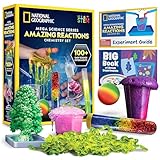
From the maker:
- Made by Blue Marble under the National Geographic name, marked for ages 8 and up (the title says 8 to 12).
- Materials for 15 chemistry experiments, including growing a crystal tree and changing a liquid’s color with your breath.
- A bonus guide with 85 more experiments that use common household items.
- Uses test tubes, beakers and pipettes.
Why it’s on the list: Not every 11-year-old is ready for a burner and a 128-page manual. This set gives a newcomer quick, visual results like glowing test tubes and a bouncy ball, so it works as a low-pressure way to find out whether chemistry clicks before you spend more on a Thames & Kosmos kit. The title gives ages 8 to 12, so it’s at the top of its age range for an 11- or 12-year-old, which suits a child who is new to chemistry rather than one who has done a lot of it.
Keep in mind: Only 15 experiments use the included materials; the other 85 need things from around the house. A 12-year-old with some experience may find it too simple, so pick the C1000 or C2000 instead in that case.
5. Molymod MMS-008 Organic Chemistry Molecular Model Set

From the maker:
- A student set for grades 7 to 12, used to show functional groups and other organic chemistry ideas.
- Plastic atom parts and links for building models; the listing gives 50 atom parts and 62 links.
- Atoms are color-coded to national standards and range from 17mm to 23mm across.
- Comes in a plastic storage box with four compartments.
Why it’s on the list: Around 11 and 12, kids start meeting atoms and molecules in science class, usually as flat diagrams. A model kit lets them build molecules in 3D, with each atom in its standard color, and see how the pieces connect. There are no chemicals, so it’s also an option for a family that isn’t ready for a wet-lab set, and it pairs well with any of the Thames & Kosmos kits.
Keep in mind: It’s a classroom-style model set, not a toy, and the listing doesn’t mention an instruction or experiment book, so it works best for a child who likes to tinker alongside schoolwork or a video. Molymod lists grades 7 to 12, so a younger 11-year-old may need a little help at first.
6. Genius Games Ion: A Compound Building Game (2nd Edition)

From the maker:
- A pick-and-pass card game for 2 to 7 players that takes around 20 to 30 minutes.
- Players match positive and negative ions to build neutral compounds, and score for noble gases and goal cards.
- Covers ionic bonding, cations and anions, and acids and bases.
- Includes a Science Behind booklet and a harder radioactive variant for 4 or more players.
- The maker says its games are peer-reviewed by a team of PhD scientists.
Why it’s on the list: Ion turns one of the trickier ideas in early chemistry, balancing charges, into a quick card game that the whole family can play. An 11- or 12-year-old will pick up the rules fast, and the radioactive variant gives them a harder version once the basic game feels easy. It’s a good gift for a kid who likes games more than lab work, or as an add-on to a chemistry set.
Keep in mind: The maker’s age is 8+, but the listing pitches it at high schoolers and adults too, so expect it to suit older siblings and parents as well. You need at least two players.
7. The Elements by Theodore Gray (paperback)

From the maker:
- Written by Theodore Gray with photography by Nick Mann; 240 pages.
- A photographic tour of the 118 elements of the periodic table.
- Book 1 of Gray’s Elements trilogy.
Why it’s on the list: Many 11- and 12-year-olds meet the periodic table for the first time in middle school, and this book makes it feel real by showing what each element actually looks like. It’s an easy book to dip in and out of, so it suits kids who read for fun as well as budding chemists. It also makes a good companion to any chemistry set on this list.
Keep in mind: It’s a reference book, not a hands-on kit, so pair it with something to do if you want an activity. The listing gives no reading age; it’s written for a general audience. For more low-cost ideas, see our list of STEM gifts under $25.
Prefer a monthly subscription?
MEL Chemistry sends a new chemistry experiment kit each month rather than one big box. MEL’s kits weren’t in stock on Amazon when we checked, so it isn’t in the list above, but our MEL Chemistry review covers how it works and who it suits.
How to choose
- Check the maker’s age first. The CHEM C1000 is marked 10+, the C2000 11+ and the C3000 12+. For an 11-year-old, the C1000 or C2000 is the closer fit; for a 12-year-old with some experience, the C3000 gives more room to grow.
- Match the set to experience, not just age. A child who has never done a chemistry kit may enjoy the National Geographic set more as a first step, even at 11 or 12.
- Plan for supervision. All three Thames & Kosmos sets require adult supervision, and the C2000 and C3000 include an alcohol burner. Their listings say safety goggles are in the box; keep them on for every experiment.
- Mix in a non-lab pick. The Molymod kit, Ion and The Elements need no chemicals at all, which makes them easy add-ons or a good choice for a family not ready for a home lab.
- Treat ages as a guide. A maker’s age marking is a starting point, not a promise that every child will use a product independently.
Frequently asked questions
What’s the best chemistry set for a 12-year-old?
For a 12-year-old who already enjoys science, the Thames & Kosmos CHEM C3000 is the most complete set here, and the maker’s age of 12+ matches exactly. For a 12-year-old who is newer to chemistry, the CHEM C2000 is a gentler step with real glassware, and the National Geographic set is the lowest-commitment way to start.
What chemistry set should I get for an 11-year-old?
The CHEM C2000 is marked 11+, so it’s the closest fit for an 11-year-old who is ready for a real lab set with adult supervision. The CHEM C1000 (10+) is a lower-cost lab set without the burner. If your child hasn’t done much chemistry yet, the National Geographic Amazing Chemistry Set gives quicker results to build interest first.
Do these chemistry sets need adult supervision?
Thames & Kosmos says the CHEM C1000, C2000 and C3000 all require adult supervision. All three list safety goggles, and the C2000 and C3000 include an alcohol burner. Follow the safety rules in each manual, and plan to be nearby for the National Geographic set too. The Molymod kit, the Ion game and The Elements involve no chemicals.
Is a chemistry set too advanced for 11- and 12-year-olds?
Not if you match the set to the child. Four of the seven picks carry a maker’s age of 8+, 10+ or 11+, the C3000 starts at 12, the Molymod kit is listed for grades 7 to 12, and The Elements is a general-audience book. The more advanced sets ask for supervision, which is about safety as much as difficulty.
More STEM gift guides
- Best STEM toys for 11-year-olds
- Best STEM toys for 12-year-olds
- Best chemistry sets for teens
- MEL Chemistry review
Last update on 2026-11-23 / Affiliate links / Images from Amazon Product Advertising API