

Best Science Gifts for 10-Year-Olds: 4 Picks by Interest

A good science gift for a 10-year-old gives them something worth investigating: a ball that stops halfway along a track, a circuit that finally works, or a familiar object that looks completely different under magnification. The best choice depends less on how many experiments fit on the box and more on what your child will want to do again tomorrow.
STEMGeek may earn a commission if you buy through some links on this page.
Our first choice for a child who loves building is the GraviTrax BASE Starter Set 22410. For a future electrical engineer, choose Snap Circuits Classic SC300. Laser Maze suits a puzzle fan, while Carson’s MicroFlip offers a closer look at everyday objects—with an adult involved and an important age-label caveat below.
These recommendations draw on manufacturer information and manuals, not hands-on testing. STEMGeek may earn a commission through some links on this page.
Science gifts at a glance
| Gift | Best fit | Manufacturer age | Before you wrap it |
|---|---|---|---|
| GraviTrax BASE 22410 | Building and changing marble tracks | 8+ | Plan a place to leave the track assembled |
| Snap Circuits Classic SC300 | Following projects to explore electronics | 8+ | Four AA alkaline batteries, not included |
| ThinkFun Laser Maze 44001014 | Solving individual logic challenges | 8+ | Two LR44 batteries included |
| Carson MicroFlip MP-250 | Adult-assisted microscopy | Minimum age not verified | One AA alkaline battery required; phone optional |
Our science gift picks
1. GraviTrax BASE Starter Set 22410: for curious builders
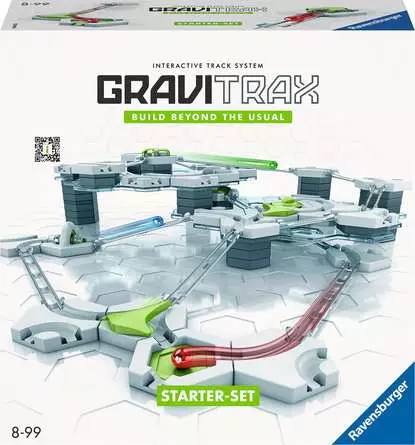
Marble runs make a lovely introduction to physics because a design has to work in the real world. With GraviTrax BASE 22410, the attraction is building a route, watching the ball travel, then deciding what to change. Ravensburger rates this construction set 8+ and describes it as a way to explore gravity and rolling behavior.
I’d choose it for a child who enjoys making their own solutions rather than completing a fixed set of puzzles. Try asking them to predict where the ball will stop before a run, then change one part of the track. That turns rebuilding into a simple experiment without making play feel like homework.
The tradeoff is space: consider where an unfinished track can stay between sessions. Compatible GraviTrax additions offer room to expand, but start with the starter set before buying extras. Look for item 22410; this recommendation is a different model from the older 27597 starter set.
See GraviTrax BASE 22410 at Ravensburger
2. Snap Circuits Classic SC300: for exploring electronics

Snap Circuits Classic SC300 gives a budding electrical engineer a structured starting point. The snap-together format lets children assemble circuits from project instructions without soldering. Elenco rates it 8+, and the Classic version is the 300-project option—not an interchangeable name for every Snap Circuits box.
This is the pick for a child who likes following a diagram and seeing whether the result behaves as expected. When something doesn’t work, matching the circuit back to the instructions is part of the activity. It is less suitable if the main wish is to write code or build a moving robot; the focus here is electronics.
Add four AA alkaline batteries, which are not included. Elenco advises adult discretion and supervision. Its manual says to use the supplied battery holder, never connect circuits to household outlets or other power sources, and never leave a circuit unattended with batteries installed. Read those instructions together before beginning.
Check Snap Circuits Classic SC300 on Amazon · Read Elenco’s SC300 manuals
3. ThinkFun Laser Maze 44001014: for puzzle lovers
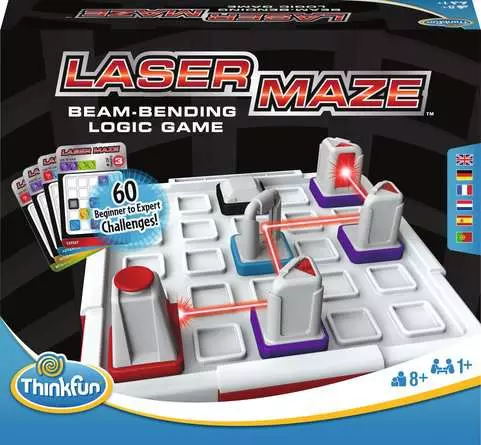
Some children want a clear problem to solve before they start experimenting. ThinkFun Laser Maze takes that approach: use the game pieces to redirect a laser beam through a challenge. Ravensburger lists this exact model, article 44001014, for ages 8+, with 60 challenges and 11 game pieces.
I’d put this ahead of a construction kit for a child who enjoys sitting with a puzzle and trying another arrangement when the first idea fails. Whether the light reaches its target gives the problem a physical outcome; they can compare the route they expected with the result. Asking them to explain their plan before testing it adds a useful discussion about light and direction.
It is a one-player game, so choose something else if you want a competitive family board game. Adults can share the thinking, but there aren’t separate player roles. The two required LR44 batteries are included. Follow the supplied product instructions when setting up and using the game.
See ThinkFun Laser Maze at Ravensburger
4. Carson MicroFlip MP-250: for looking closer together

The Carson MicroFlip MP-250 offers 100–250× magnification, slide viewing and a smartphone clip. Its appeal is turning “what does that look like close up?” into an activity: start with familiar materials such as paper or fabric, compare what you see, and sketch the differences.
There is an important qualification for this age-specific guide: we have not verified a manufacturer minimum age for the MP-250. We suggest it only as an adult-assisted activity for a 10-year-old; that is our editorial judgment, not a Carson age rating. It suits a family willing to help with setup and focusing rather than a child expecting instant results from a toy.
One AA alkaline battery is required. A phone is optional for using the clip, and prepared slides are an optional extra. Plan a few things to examine together so the first session has a starting point. Carson’s manual warns against looking directly at the LED or UV light; read the guide together before use.
Check Carson MicroFlip MP-250 on Amazon · Read Carson’s MP-250 guide
How to choose a science gift they’ll use
Start with the activity, then the subject. A child can love space or animals without enjoying a box of written experiments. Builders may prefer GraviTrax; diagram followers may take to Snap Circuits; puzzle fans have Laser Maze. For chemistry specifically, explore our chemistry sets for 10-year-olds.
Plan the first session. Have the required batteries ready, make room for the project, and leave time to read instructions together. A manufacturer’s age label is a starting point for choosing a kit, not a promise that every child will use it independently. Check the exact model’s warnings, especially in a home with younger siblings.
Leave room for their questions. You don’t need to turn every session into a lesson. “What do you think will happen?” and “What changed?” can be enough. A notebook for predictions and drawings makes a useful companion gift without committing you to another kit.
How we chose these gifts
We compared the exact models using manufacturer product pages, age information and available manuals. The links beside each pick lead to those sources or a buying option. Our recommendations about interests and adult involvement are editorial judgments; this update adds no new hands-on testing. Prices, sellers and availability can change, so check the exact model and included items before ordering.
Last update on 2026-10-24 / Affiliate links / Images from Amazon Product Advertising API